
Design Before Drift: Why I Build My Life Like an Architect

Most people drift into their lives. I'm designing mine.
Start here: This essay explains the philosophy behind everything I write.
Why Life Defaults to Drift
Life rarely collapses all at once.
It drifts.
Most people simply react to whatever shows up.
They drift by default.
And for a while it feels normal.
You wake up early for work.
The day fills with tasks, messages, and responsibilities.
Weeks turn into months.
Months into years.
And suddenly your life has a structure...
you never designed.
The Drift Default
The tendency for life to become reactive instead of intentional.
Drift is invisible while it's happening.
You only see it in hindsight.
Years can pass before people notice something uncomfortable:
- A job taken out of necessity.
- A habit formed without thinking.
- Bills that quietly multiplied.
And suddenly they're living inside a building they never designed.
For a long time, I thought motivation was the answer. I'd read something inspiring or have a burst of energy about the future, plan a few things, and then nothing structural would change. The momentum faded and most days felt like maintenance again. Pay the bill. Fix the problem. Chase the opportunity. Repeat.
The Moment I Saw the Structure
I remember driving home from work one night thinking about my finances and realizing none of this had been intentionally designed. That's when the architect analogy began making sense. No architect would build a house this way. With no blueprint. No measurements. No structural plan.
Architects don't improvise structures.
They design them first.
But that's basically how most people approach life: they stack decisions on top of circumstances and hope it holds up. Eventually I realized I didn't want to keep doing that. I wanted to design it. Life isn't a building, of course.
But The Blueprint Mindset stuck with me.
Thinking Like an Architect
Architects trust structure more than emotion. Long before a single brick is laid, there's a blueprint. Measurements are calculated. Load limits are tested.
Drifting is reactive.
Designing is intentional.
Eventually, I realized the problem wasn't motivation itself – it was relying on it.
A system doesn't ask how you feel today. It keeps working on ordinary days and difficult days. That's what makes them reliable.
The Systems Principle
Systems Outperform motivation over the long term.
Motivation is weather.
Systems are climate.
So, instead of chasing motivation, I started building small systems at first: Simple rules for managing money, planning time, learning consistently.
It was quieter than a breakthrough, but it produced something better: stability.
Once life stopped feeling chaotic, I noticed options that weren't visible before. Architects don't build for today; every support column is designed to hold weight over decades. The more carefully a structure is designed, the more usable and flexible it becomes. Life works in the same way.
Most online advice talks about intensity – hustle harder, grind until you break - but real life design isn't like that.
The Architect Method
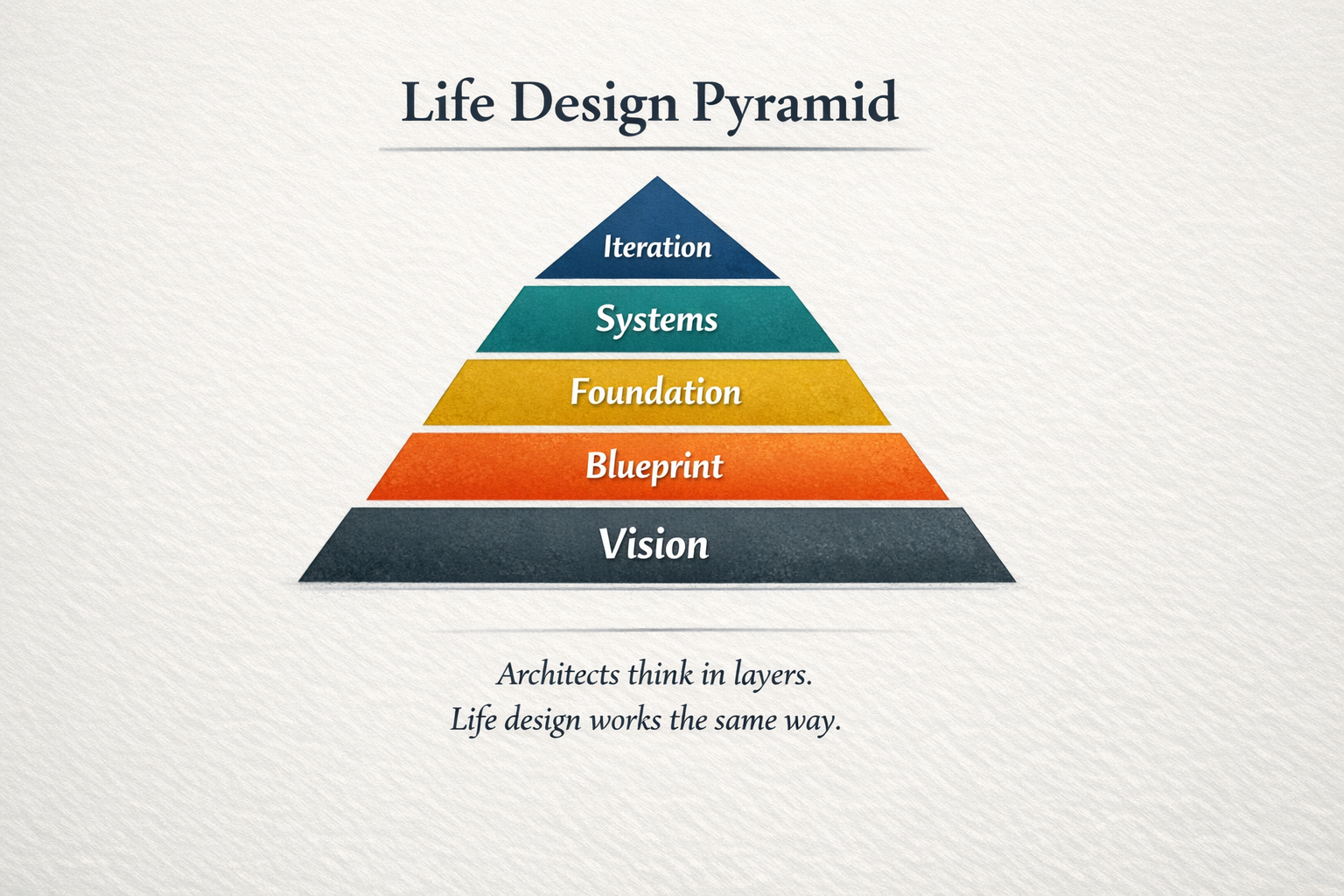
- Vision - The life you're trying to build
- Blueprint - The plan guiding your decisions
- Foundation - Stability (health, finances, habits)
- Systems - Daily structures that carry the load
- Iteration - Adjusting the design over time
At first discipline feels restrictive and systems feel rigid. Later, you realize the opposite is happening.
Structure creates stability.
Stability creates options.
Options create freedom.
A designed life doesn't happen all at once.
First comes the vision.
Then the blueprint.
Then the foundation.
Systems carry the weight.
Iteration improves the structure.
That's how architects build buildings.
And that's how I'm building my life.
Design Before Drift
I'm still figuring out this paradox and some days reacting feels easier than designing. Life will always contain uncertainty, but now those moments don't derail the structure.
I'm not trying to live a perfect life.
I'm trying to live a designed one.
Most lives are built by drift; few are built by design.
I'd rather build mine that way. Intentionally.
Like an architect.
Follow The Design
This essay is the foundation of a larger philosophy I'm building around intentional life design. If this idea resonates, you can follow along as there's more coming:
- The Drift Default
- The Systems Principle
- The Blueprint Mindset